According to official Nasa Documents "The Apollo Guidance Computer was fairly compact for a computer of its time. The CM housed the computer in a lower equipment bay, near the navigator's station. Block II measured 24 by 12.5 by 6 inches, weighed 70.1 pounds, and required 70 watts at 28 volts DC. The machine in the lunar module was identical. The story of memory in the Apollo computer is a story of increasing size as mission requirements developed.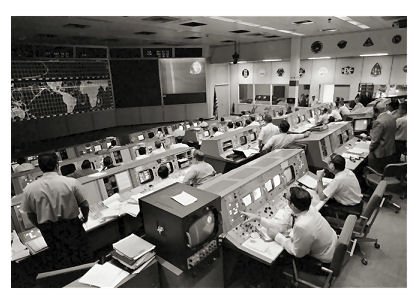 In designing or purchasing a computer system for a specific application, the requirements for memory are among the most difficult to estimate. NASA and its computer contractors have been consistently unable to make adequate judgments in this area. Apollo's computer had both permanent and erasable memory, which grew rapidly over initial projections.
In designing or purchasing a computer system for a specific application, the requirements for memory are among the most difficult to estimate. NASA and its computer contractors have been consistently unable to make adequate judgments in this area. Apollo's computer had both permanent and erasable memory, which grew rapidly over initial projections.
I can remember the Commodore 64, also known as the C64 or the CBM 64 computer released in the early 80's. A very powerful machine for it's time. The 64 was produced more than 10 years after the Apollo program.TEN YEARS!!. Anyone who owned one knows how S L O W the computer was and how unreliable it was. But it was introduced 10 years after the Apollo missions. If I said " We went to the moon and back with the C64" you would probably say "No Way"
In 1981 IBM released their PC computer. This computer had more than 8 times the memory then the one used on the Apollo Missions.(EIGHT TIMES MORE THAN 10 YEARS AFTER THE MOON MISSIONS).
IBM produced a processor in 1980 that had a clock speed of 4.077MHz. The Computer on the Apollo missions had a speed of 1.024 MHz. This was in 1980. Was the Apollo Computers fast enough, smart enough and dependable enough to get a man on the moon not ONCE but MULTIPLE times? The computer on the Apollo missions only had ONE ERROR message. Can you imagine working on your computer at home and only having one error message. Imagine typing and getting the message "ERROR" what was the cause of the error was it my Photoshop, My iTunes or what the heck caused the error? The astronauts only had that one message.... To me this is odd.
If you stop and think about it how could our technology in the late 60's and early 70's have enough computer power to get a manned space mission to the moon, land, explore and safetly return to earth? Compared to todays computing power the computers used to get our astronauts to the moon and back were at least 1,300 times less powerful than the Apple iPhone5. Unbelievable for sure!!
So "Did We Or Didn't we Land on the Moon"? Our answer would be....NOT SURE.
Take a look at the video below. The author explains how the Apollo computers "could have" got our men to the moon and back. In the video look at the size of the computers and some of the comments posted. Again...I'm not 100% convinced.